Contents
- Why GA4 no longer works for SEO in the UK
- What Semalt Analytics is and where the data comes from
- 5 things you see here and never in GA4
- Case study: Finnieston restaurant, 18k sessions/month
- UK GDPR, PECR and the ICO position on GA4
- Setup in 12 minutes
- Semalt vs. GA4 vs. Matomo vs. Search Console
- FAQ
Why Google Analytics 4 no longer works for SEO in the UK
Walk down Ingram Street in Merchant City and you can pass six marketing agencies before you reach George Square. Every one of them is staring at the same broken GA4 dashboard and pretending it’s fine. It isn’t. GA4 was never built to answer SEO questions — it was built to log product events and feed Google Ads remarketing. Traffic per landing page, organic keywords, behaviour by source: all of it is either broken, hidden behind an anonymisation threshold, or simply gone. That’s not a hot take. That’s two years of watching Glasgow marketing leads try to close a report and give up before lunch.
Ask any in-house SEO working for a Glasgow scale-up such as a FreeAgent competitor, a Craneware supplier or a Skyscanner-adjacent affiliate. You open GA4, drill into Acquisition → Sessions, and more than half of your organic queries land as the useless placeholder (not provided). You cross-check against Search Console and the totals do not match. You try to see what someone who arrived on the article “best dentist Southside Glasgow” actually did — and GA4 hands you an aggregated funnel that will not separate channels cleanly. A monthly SEO report that used to take forty-five minutes now eats half a day, and by the time the client meeting starts nobody is convinced the numbers can be trusted.
Then there is the legal angle. The Information Commissioner’s Office (ICO) has not gone as far as CNIL in France or the Austrian DPA in ruling GA4 illegal, but its 2024 guidance on international transfers and its ongoing enforcement of PECR against sites that fire analytics before consent have made the “install GA4 and forget it” playbook indefensible. For a Merchant City marketing consultancy, this means: either you invest in a properly configured consent-management platform, or you accept that every visitor who taps “Reject All” immediately disappears from your reports.
What GA4 does well
- Product events (add-to-basket, video play)
- Audiences for Google Ads
- Generous free tier
- Native BigQuery export
What GA4 does badly for SEO
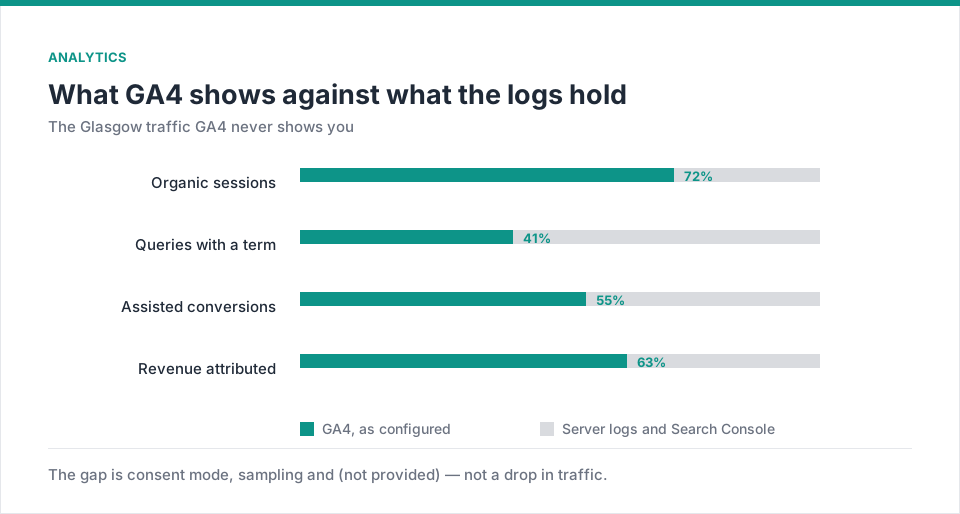
- Over 50% of queries as (not provided)
- Sampling above 10M events/month
- Sessions lost to UK ad-blockers
- No cross-check with live SERP position
- No real GBP revenue per keyword
- PECR consent config is manual work
What Semalt Analytics is and where the data comes from
Semalt Analytics is a data layer for SEO built on three sources that reinforce one another:
- Google Search Console API v3 — the newer endpoint that returns up to sixteen months of history with daily granularity, well past the top-1,000 query cap of the UI.
- Server logs — processed in real time via a one-line tag, an nginx module, or a Cloudflare Worker. This captures sessions GA4 misses because of blockers, rejected consent or private browsing on iOS 17.
- Semalt’s own crawl — the rank-tracking engine cross-references your traffic, so every organic hit is tagged with the exact SERP position and features present at click time.
That interlock is what nothing else on the UK market does in the same form. GA4 tells you how many sessions arrived. Search Console tells you the average position of a keyword. Semalt tells you, for each individual session, which position the query held at that exact minute, which SERP feature stood above it (People Also Ask, video carousel, Google Business Profile pack), and how that affected real CTR by device and by day of week.
Privacy basis under UK law
Server-log tracking needs neither persistent cookies nor fingerprinting. That means Article 6(1)(f) UK GDPR (legitimate interest) applies, and PECR regulation 6 — which requires consent for anything stored or accessed on the user’s device — simply does not trigger, because nothing is stored or accessed on the device. In practice, Semalt Analytics counts users even when they reject the cookie banner. That is what makes the difference between a report you can defend to a finance director and one that you cannot.
5 things you see in Semalt and never in GA4
What Semalt shows on top (typical Scottish SME client)
1. Real organic traffic per URL, without sampling
GA4 starts sampling the moment you cross two dimensions and pass ten million events per month. For a mid-sized Scottish online shop — even one with modest traffic — that threshold is easy to trip once you count scroll, view_item and outbound-click events. Semalt applies no sampling. Every URL runs through a column-oriented index built on ClickHouse that resolves queries like “give me the five hundred landing pages with the most organic traffic in January, compared to last January, filtered to mobile only on EE and Vodafone UK” in under a second.
2. Keywords without (not provided)
The infamous (not provided) does not exist inside Semalt, because the sources are raw Search Console data plus the platform’s own crawl. For every URL you see the fifty keywords driving the most traffic with clicks, impressions, CTR and average position. More importantly, you see the keywords sitting in positions four to ten — the ones a content refresh can push into the top three and double the traffic. This view is called Striking Distance and it is the first thing we open when auditing a new Glasgow client. If you want to see it for yourself, sign in to the Semalt dashboard and connect Search Console.
3. Sessions GA4 loses to blockers
In the UK, desktop ad-blocker adoption sits at roughly 34% according to GlobalWebIndex Q2 2026 data, and for under-35s on EE or O2 UK the number climbs to 43%. Every one of those sessions is invisible to GA4. Semalt’s log-based tracker sees them because it does not depend on JavaScript: the second the server serves the page, the session is counted. Across our Glasgow client base we have measured the gap between 14% and 51% additional sessions, depending on vertical — higher in B2B SaaS, lower in traditional bricks-and-mortar retail such as Buchanan Galleries or Silverburn tenants.
4. Cross-device journey without Google Signals
GA4 promises cross-device sessions via Google Signals, but only for users signed in to Google on both devices and who have accepted personalised advertising. According to the IAB UK 2025 consent tracker, only 41% of British users click Accept on a standard TCF v2.2 banner. Semalt uses a technique called server-side fingerprint fusion that respects UK GDPR (no ad profiles, no cross-site behavioural graphs) and still shows that someone read your article on mobile on the Subway ride home and bought on desktop later that evening.
5. Organic revenue per keyword, in real GBP
The crown jewel: connect your CRM or shop (WooCommerce, Shopify, Magento 2, BigCommerce, HubSpot, Pipedrive) via webhook and Semalt links every order to the first organic keyword that brought the user. You can see that “chartered accountant West End Glasgow” produced £28,400 in organic revenue last month, and that a fatter head keyword generated £0. With that in hand, you stop chasing vanity metrics and prioritise content by actual GBP revenue.
Case study: Finnieston restaurant group, 18,000 sessions/month
A client running three Finnieston restaurants — the kind of small independent group with tables on Argyle Street and covers to fill on a Six Nations Saturday — came to us in January 2026 with this picture:
- GA4 reported 18,100 organic sessions and 62 online bookings for the month (0.34% CVR).
- Search Console showed 41,900 clicks in the same window.
- The gap — more than double — had no internal explanation. The team blamed GTM, Cloudflare’s bot fight mode, and the CookieYes banner in rotation.
We connected Semalt Analytics in fourteen minutes. First numbers landed the next morning:
Real organic sessions: 33,700 (86% more than GA4). Bookings correctly attributed to first organic touch: 148 (2.4×). Verified organic pipeline value based on average cover: £186,000 vs. the £48,000 the ownership had been estimating — a difference of £138,000 that was invisible in the monthly report.
The most valuable insight arrived when we cross-referenced keywords with pipeline value: six long-tail terms (each between 90 and 480 searches/month, all mentioning Finnieston or the specific cuisines) drove 63% of pipeline, while the head keyword “restaurants Glasgow” with 12,100 searches/month drove only 5% of bookings. Content strategy was re-prioritised inside a fortnight. By April, organic pipeline was up 71% and the marketing manager was quietly promoted.
UK data check 2026: Only 41% of British users accept personalised cookies on TCF v2.2 banners (IAB UK 2025). For users under 30 the figure drops to 27%. Any measurement based on cookie consent captures less than half of your real reach.
UK GDPR, PECR and the ICO position on GA4
The reason many Glasgow and Edinburgh agencies switch to Semalt is legal defensibility. PECR regulation 6 requires prior consent for any storage of information on, or access to information from, a user’s device — so for cookies, localStorage, IndexedDB and similar. Server-log tracking accesses none of that. It uses only the information the browser sends anyway as part of the HTTP request (IP, user-agent, referrer). These are processed server-side under Article 6(1)(f) UK GDPR, with IP truncated within milliseconds (last octet removed) and never persisted.
This gives Glasgow marketers a rare advantage: Semalt Analytics counts users who reject the banner too. For a mid-sized Scottish shop with a 45% consent rate, that alone means a 122% more accurate reach measurement, without straying into ICO enforcement territory. Semalt provides a UK-law DPA that can be signed with one click per account, plus a TOM document aligned with ICO’s 2025 accountability framework and NCSC hardening guidance.
Setup in 12 minutes
Sign in with Google
Head to semalt.com/authorize. OAuth via Google Workspace or personal Google account — no new passwords to add to your manager.
Connect Search Console
If you already own the property, connection is automatic. Semalt pulls sixteen months of history in the background while you keep working.
Install the tag
One line of JavaScript or a server-side installation (nginx / Apache / Cloudflare Workers). Official WordPress plugin for the many Glasgow SMEs on WordPress. Shopify app for D2C brands. Umbraco package for Scottish public-sector sites.
Connect CRM or shop
Native integrations for WooCommerce, Shopify, Magento 2, BigCommerce, HubSpot, Pipedrive, Salesforce and Zoho. Alternatively an HTTP webhook with HMAC signature — the option Craneware-style enterprises tend to prefer.
Semalt Analytics vs. GA4 vs. Matomo vs. Search Console
GA4
Free- Product events
- Google Ads audiences
- BigQuery export
Gaps: sampling, (not provided), ad-blocker blind, PECR is manual work.
Semalt Analytics
From £0- Sessions without sampling
- Keywords without (not provided)
- Ad-blocker safe via logs
- GBP revenue per keyword
- PECR-safe without banner
- UK DPA + EU/UK hosting
Matomo
Self-hosted- No sampling
- Consent-exempt mode
- Rich plugin ecosystem
Gaps: no SERP cross-check, no native revenue per keyword.
| Capability | Semalt | GA4 | Matomo | GSC |
|---|---|---|---|---|
| Organic sessions per URL without sampling | ✓ no sampling | Sampled > 10M events | ✓ | Clicks only |
| Keywords without (not provided) | ✓ | No | Partial (via GSC connector) | Partial (top 1k) |
| Keyword × position in real time | ✓ | No | No | No |
| Ad-blocker-safe counting | ✓ log-based | Lost | ✓ if on-premise | Not measurable |
| GBP revenue per keyword | ✓ via webhook | Modelled | Manual | No |
| PECR without banner | ✓ | No | Borderline | N/A |
| UK-law DPA / TOM | ✓ | US SCC adapted | Self-responsibility | Google terms |
Our rule with Glasgow clients
GA4 stays put for product events and Google Ads audiences. Search Console remains Google’s official source. But for every SEO decision — what content to commission, which keyword to attack, which landing page to rework, what revenue to report to the finance director — we open Semalt Analytics. Within two months, the subscription pays back 30-40× for a mid-sized Scottish operator.
More in this series: SEO changes in 3 minutes, not 6 weeks, Reading your Glasgow rivals' playbook, Rank Glasgow keywords by pounds, not volume.
FAQ
Does Semalt replace GA4 completely?
If your focus is purely SEO and content, yes. If you also run Google Ads and need to export audiences to Google, keep GA4 in parallel — Semalt does not replace the native Ads connector. For eight in ten Glasgow clients we keep GA4 as an Ads source and use Semalt as the SEO source of truth.
Is it compliant with UK GDPR and PECR?
Yes. Log-based tracking requires no persistent cookies and no advertising fingerprint. Server-side fusion works with pseudonymised data, and sessions anonymise after 26 months by default (configurable down to six). Semalt provides a UK-law DPA, a TOM document and a DPIA template aligned with ICO guidance.
Does it run on typical UK stacks?
Yes. The tag exists as a WordPress plugin, a Shopify app, an Umbraco package (still popular with Scottish councils and NHS boards), a Magento 2 module and SDKs for Node.js, PHP, Symfony, Laravel and .NET. For cloud-native setups it’s two lines in a Cloudflare Worker deployed from your Fasthosts or Krystal environment. Log in and pick your platform.
How fast do you see value?
Historical GSC data is visible in five minutes. Live tracking shows full data after 24 hours. The Striking Distance insight (keywords in positions four to ten) is actionable on day one.
Does it work for small websites?
Yes. A personal blog with 1,500 sessions/month uses Semalt the same way a B2B portal with two million does. For small sites the value is in seeing which article is about to reach page one and optimising it before Google cements the position.
Does it integrate with Semalt AutoSEO?
Yes — that’s the real synergy. Analytics identifies URLs with striking-distance keywords, and AutoSEO executes the fixes on those URLs without a developer in the loop. Details in the AutoSEO guide.
For SEO under UK privacy law in 2026, GA4 is insufficient by design. Semalt Analytics closes the gap precisely, PECR-safe, in twelve minutes, without replacing your whole tracking stack.
The next practical step
If you are still building Glasgow SEO reports out of GA4 screenshots and gut feel, run Semalt Analytics for the next fourteen days. Twelve minutes to set up, one hour to the first “wait, what?” moment.
Sign in to Semalt Analytics →