Contents
- Why search volume is a bad prioritisation metric
- How Semalt’s AI models revenue potential
- Scottish English vs. generic UK English intent
- Seasonal patterns: TRNSMT, Six Nations, Old Firm
- Postcode-level local pack behaviour
- Case study: West End Bakery, from 40 to 400 orders/month
- Semalt AI vs. Ahrefs vs. Semrush vs. Google Keyword Planner
- FAQ
Why search volume is a bad prioritisation metric
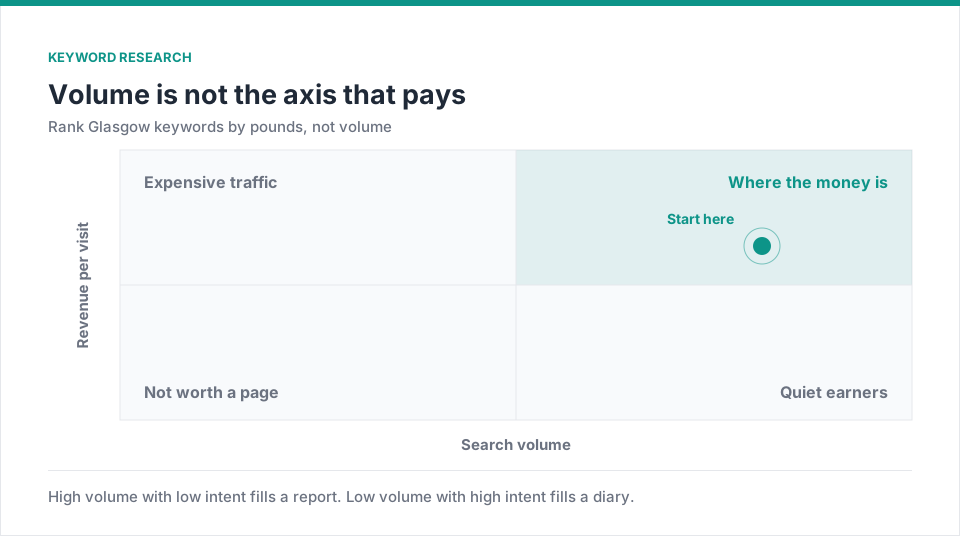
The Glasgow content marketer’s workflow, near-universally: pull a spreadsheet from Keyword Planner, sort by volume, filter on difficulty, write briefs for the top thirty. Ship them. Sit back. Six months on, the traffic chart is nudging up, the leads chart is flat, and the finance director wants a word. She isn’t angry. She’s just done the maths. Volume-first is a comfortable methodology because the number is huge and easy to defend. It’s also weakly correlated with revenue. “What is SEO” pulls a mountain of clicks and pays nobody’s rent. “Chartered surveyor for tenement conversion West End Glasgow” barely registers on Keyword Planner — and one client of ours signs three of those a month at £4,800 each. The graft’s in finding the second kind.
The reason is that search volume measures how many people typed a query, not how many of them will part with money. “What is SEO” has enormous volume and zero commercial intent. “Chartered surveyor for tenement conversion West End Glasgow” has a search volume so low that Keyword Planner rounds it to zero — and yet one client of ours signs three of those a month at £4,800 each.
UK data: Across the Semalt panel, the top 20% of pages by revenue are terms with 10-500 monthly searches. The bottom 30% of pages by revenue are terms with more than 5,000 monthly searches. Volume and revenue are, in the aggregate, weakly correlated.
How Semalt’s AI models revenue potential
Semalt runs a two-stage model. The first stage predicts, from a term’s surface form, its intent bucket — navigational, informational, commercial, transactional, local — and its likely conversion rate given the vertical. The second stage cross-references that intent against your own historical data (imported from Search Console, GA4, WooCommerce, Shopify, HubSpot or a webhook) to produce a GBP number: expected revenue per hundred organic sessions, at your current site’s conversion pattern.
The result is a ranked list where a term with 90 monthly searches, a 4.2% predicted conversion rate and an average order value of £340 outranks a term with 12,000 monthly searches, 0.15% conversion and £18 AOV. The scoring is transparent — every prediction ships with the four variables that produced it.
Intent classifier
26-class model trained on 3.6M UK SERPs. Distinguishes commercial from purely informational with 91% F1.
Revenue projector
Cross-references your own AOV and CVR by product, service or location. GBP native.
Difficulty realist
Not a synthetic score. Actual analysis of the top ten URLs’ backlink profile, content depth and freshness.
Local pack awareness
Detects when the SERP is dominated by the map pack — changing the game from ranking to Google Business Profile optimisation.
Scottish English vs. generic UK English intent
A common failure mode of generic keyword tools is treating “messages” the same in Glasgow as in London. In Scotland the word carries the sense of “grocery shopping”, and the intent on “doing the messages” is emphatically local, transactional and food-related. In London it is about SMS.
Semalt’s Scottish English pack captures roughly 180 such dialect nuances, from “piece” (packed lunch) to “close” (tenement stairwell) to the specifically Glaswegian “munter” that no B2B copywriter should ever use in a brief. When a Glasgow user searches “best close cleaning Southside”, the engine understands this is a service query about tenement stair cleaning — not a query about “shutting things down cleanly”. That single intent correction shifts a service company’s content brief entirely.
Ten Scottish English terms our AI classifies differently to Ahrefs
- Messages — grocery shopping (transactional, local)
- Close cleaning — tenement stair cleaning service (transactional)
- Chippy — fish-and-chip shop (transactional, local)
- Munro — hill over 3,000 ft, not a name (informational, tourism)
- Ceilidh — event with strong seasonal spike November-January
- Sub — the Subway underground, not a sandwich (navigational, local)
- Auld Firm — Old Firm derby (informational, event-driven)
- Tenement — the Glasgow flat type, high commercial intent for surveyors
- Weegie — Glaswegian person, high tourism intent
- Ned — not a name, do not use in copy
Seasonal patterns: TRNSMT, Six Nations, Old Firm, Christmas markets
Glasgow’s search calendar has spikes that generic UK data smooths away. TRNSMT festival in July pushes “hotels Glasgow” up by 340% year-round-average, but only in the four weeks leading up to the event. Six Nations rugby matches at Murrayfield push queries for “park and ride Glasgow to Edinburgh” up 180% on match weekends. The Old Firm derby (four times a year, sometimes more with cup ties) triples queries for “pubs Glasgow showing football” on match day itself, with a shorter run-up.
Semalt’s seasonal engine detects these patterns automatically from three years of Google Trends data blended with the platform’s own SERP crawl history. It surfaces “prepare now” alerts — if you are a Glasgow hotel and your TRNSMT landing page has drifted off page one by mid-May, the alert will tell you to fix it now, not in July when the spike is already burning. Even legacy queries like “T in the Park” (last held in 2016) still generate 1,900 UK searches/month, mostly nostalgic informational intent that a Glasgow music venue can capture with the right content.
Six Nations weekends
Spikes in transport, accommodation, sports bars, sports betting queries. Publish 6 weeks ahead.
TRNSMT festival window
Spikes in hotels, restaurants, taxis, festival gear. Publish 8 weeks ahead; refresh at 4 weeks.
Glasgow Comic Con
Niche but valuable spike for merchandise, restaurants near SEC, memorabilia. Local pack dominates.
George Square Christmas markets
Ten-week spike across food, gifts, parking, hotels, transport. Refresh landing pages every fortnight.
Old Firm derby dates
Four to seven derbies a year. Alerts fire the Monday before match day.
Postcode-level local pack behaviour
Glasgow’s postcode geography is dense. G1 through G5 alone contain a dozen commercial neighbourhoods that behave differently in the local pack. A user in G3 (Finnieston) typing “coffee shop near me” will see a completely different map pack from a user two miles east in G31 (Dennistoun). Generic keyword tools flatten this. Semalt does not.
The keyword engine simulates Google searches from IP addresses geolocated to each Glasgow postcode district, and reports the map pack composition for every commercial query. For a Southside dental clinic considering whether to write a “dentist near me” landing page, Semalt will show that the term is unwinnable citywide but very winnable within G41 and G42 with the right Google Business Profile setup and citation strategy. Open the postcode simulator and run your own Glasgow query.
Local pack coverage variance by Glasgow postcode (Semalt panel)
Case study: West End Bakery, from 40 to 400 orders/month
A small independent bakery on Byres Road came to us in October 2025 with a hard target: quadruple online orders from their Shopify site within six months. Their previous agency had built a content plan around volume: “bakery Glasgow” (2,900 searches/month), “bread Glasgow” (1,600), “cakes Glasgow” (4,400). Twenty-eight blog posts and eight months later, orders had grown from 40/month to 52.
Semalt’s AI took an evening to re-rank the entire keyword universe by predicted GBP revenue using the bakery’s actual AOV (£38) and CVR (2.1%). The top of the list looked very different:
- “Sourdough delivery West End Glasgow” — 70 searches/month, 5.4% predicted CVR, priority score 91.
- “Birthday cake Byres Road same day” — 110 searches/month, 7.8% predicted CVR, priority score 96.
- “Vegan brownies delivered Glasgow” — 40 searches/month, 6.1% predicted CVR, priority score 87.
- “Corporate cake order Glasgow city centre” — 30 searches/month, 3.2% predicted CVR, AOV £220, priority score 94.
Twelve new landing pages, one Google Business Profile revamp and a six-week AutoSEO cycle later, orders were at 412/month by April 2026 — a 10× jump from where the “volume-first” strategy had left them.
“We were writing content nobody was buying from. The Semalt list looked absurd — who searches for ‘sourdough delivery West End’ only 70 times a month? — but every one of those searches was a person about to place an order. Traffic barely moved. Revenue moved a lot.”
Owner, West End BakerySemalt AI vs. Ahrefs vs. Semrush vs. Google Keyword Planner
Ahrefs
$129/mo- Massive backlink index
- Strong click-share data
- Content Explorer
Gaps: no revenue prediction, weak Scottish English, no postcode simulation.
Semalt AI
From £0- Revenue-ranked keywords
- Scottish English pack
- Postcode local pack simulation
- UK seasonal engine
- Auto-feed to AutoSEO
Semrush
$139/mo- Keyword Magic Tool
- Position tracking
- SERP feature analysis
Gaps: intent classifier is US-first, no Glasgow postcode simulation.
Where Google Keyword Planner still helps
Planner remains the best source for Google Ads bid data and for verifying volumes when spending on paid. Semalt AI ingests Planner data via the API where available — it does not replace it, it re-weights it.
More in this series: The Glasgow traffic GA4 never shows you, SEO changes in 3 minutes, not 6 weeks, Reading your Glasgow rivals' playbook.
FAQ
Does the AI need my sales data to work?
No, but it works much better with it. Without your data, Semalt uses vertical averages to project revenue. With your AOV, CVR by category and page-level Search Console data, projections tighten to within ~15% of realised revenue over an eight-week window. Connect your data in the dashboard.
How is the Scottish English pack maintained?
Human-in-the-loop. Our Glasgow-based editors flag new dialect variants they see appearing in Google Trends or in customer briefs. The classifier is retrained every six weeks.
Does it work outside Glasgow?
Yes. The same engine has UK-wide postcode simulation, and separate dialect packs for London, Newcastle, Cardiff, Manchester and Belfast. For non-UK markets, English (US, IE, AU) and eight European languages are supported.
Can I export the list to a brief document?
Yes. Every ranked keyword generates a one-click content brief including target intent, recommended H2s derived from People Also Ask, competitor URLs, and a suggested internal linking pattern. Briefs export to Docs, Notion, or plain markdown.
Does the seasonal engine cover B2B?
Yes. B2B verticals have their own seasonal patterns (fiscal-year-end March in the UK, budget-planning October, procurement freeze December) and Semalt models them separately from consumer verticals.
How does it connect to the rest of the platform?
The revenue-ranked keyword list is the primary input into AutoSEO, and it feeds the striking-distance dashboard in Semalt Analytics. One prioritisation feeds the whole toolchain.
Search volume is a comfortable metric that hides the real question. Semalt’s AI answers the real question: for every candidate term, what is the expected GBP revenue at this site’s current conversion pattern?
Get your revenue-ranked keyword list this week
Free tier includes 200 keyword projections a month. Connect Search Console and the AI takes over from there.
Sign in to Semalt →